

 admin
A free zone is a smart place to start. Costs are lower, setup is faster, and you get full foreign ownership from day one. But as your business grows, the free zone can start to feel like a wall. You cannot sell directly to UAE customers. You cannot bid on government contracts. At some point, to truly setup a business in Dubai that reaches the full market, moving to the mainland becomes the logical next step.
The Free Zone Served You Well – Until Now
Most international entrepreneurs choose a free zone first. It makes sense. Lower setup costs, a flexi-desk instead of a physical office, and fast registration make free zones a great launchpad. Many consultants, tech companies, and service providers build their first few years entirely inside a free zone.
But free zones come with a clear boundary. You can only trade with other free zone companies or international clients. If you want to setup a business in Dubai that actively sells to local UAE businesses or individuals, not just ship goods out or invoice foreign clients, the mainland is where that happens.
The question is not whether to make the move. The question is when.
Four Clear Signs You Are Ready to Transition
There is no fixed rule on when to move. But there are common signals that tell you the free zone has done its job and the mainland is now the right base.
Signal 1: You Are Losing UAE Clients Because You Cannot Invoice Locally
A free zone company can invoice UAE mainland clients. But the transaction sits in a grey zone. Some UAE businesses prefer not to deal with free zone suppliers. Others require a mainland trade licence before they will sign a contract. If you are losing deals because of your licence type, that is a clear signal.
Signal 2: You Want to Bid on Government Contracts
UAE government tenders almost always require a mainland licence. Free zone companies are typically excluded. If your business is moving into government supply, logistics, construction, healthcare, or education, sectors where public contracts are large, you will need to setup a business in Dubai on the mainland before you can compete.
Signal 3: You Need a Retail Presence or a Physical Branch Anywhere in Dubai
Free zones restrict where you can open physical offices and stores. You can only operate within your zone’s geography. If you want a shop on Sheikh Zayed Road, a service centre in Business Bay, or a warehouse in Al Quoz, you cannot do that under a free zone licence alone. A mainland setup removes those limits.
Signal 4: Your Team Has Outgrown Your Visa Quota
Free zone visa quotas are tied to your office package. A flexi-desk typically allows two to five visas. As you hire more UAE-based staff, you hit the ceiling. Mainland companies tie their visa quota to office size, more space means more visas. Expanding your team can push the decision faster than anything else.
Three Ways to Make the Transition
You have three options when moving from a free zone to the mainland. Each suits a different situation. Understanding them before you act will save you both time and money.
| Pathway | What It Is | Best For |
| Free Zone Mainland Operating Permit | A permit under Resolution 11 of 2025 that lets your free zone company operate on the mainland without a new entity | Non-regulated activities wanting a fast, low-cost entry |
| Mainland Branch Licence | A DET branch licence linked to your free zone parent company | Established businesses wanting a permanent mainland presence |
| New Standalone Mainland Company | A fully separate DET-licensed company with its own trade licence and structure | Businesses that want a clean split or different activity scope |
The fastest option today is the Free Zone Mainland Operating Permit. It was introduced by Dubai Executive Council Resolution No. 11 of 2025. You keep your free zone company and add a mainland operating permit on top. No new entity. No winding down your existing setup.
How the Free Zone Mainland Operating Permit Works
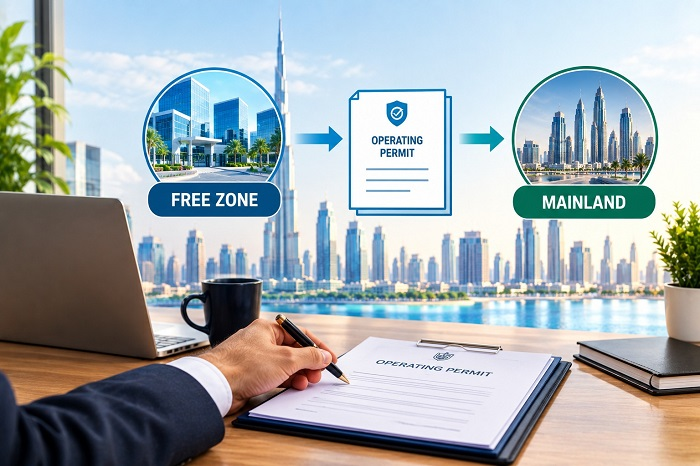
This permit is available through the Invest in Dubai (IID) portal. It is designed for free zone companies that want to start selling on the mainland without the cost or complexity of a full branch setup.
Who Is Eligible?
In the first phase of this policy, the permit covers non-regulated activities. These include IT and software, management consulting, marketing, e-commerce, logistics, and general trading. Regulated sectors, such as healthcare, finance, education, and real estate, are expected to be included in later phases.
One important note: DIFC-licensed financial companies are excluded from this permit. And the activity on your permit must exactly match the activity on your free zone licence.
What Does It Cost?
The temporary permit costs AED 5,000 for up to six months. If you want an annual branch licence, the government fee is AED 10,000 per year. Add to this the cost of your office lease and Ejari registration, separate bookkeeping for mainland activity, and professional advisory fees. A realistic first-year total falls between AED 7,000 and AED 15,000 or more, depending on your setup.
How Long Does It Take?
For straightforward applications where your documents are complete and your activity is clearly non-regulated, processing takes three to five working days. If the DET needs to clarify your activity or request additional documentation, expect one to four weeks. The most common delays come from inconsistent documents, a mismatch between your licence, website, and contracts.
Documents You Need for the Transition
Whether you go through the operating permit route or the full branch licence route, you will need a standard set of documents. Preparing these in advance cuts your waiting time significantly.
- Current free zone trade licence (valid, not expired)
- Memorandum and Articles of Association of the free zone company
- Passport and Emirates ID copies of all shareholders and the company manager
- No Objection Certificate (NOC) from your free zone authority
- Ejari-registered tenancy contract for your mainland office or branch (if setting up a branch)
- Any sector-specific approvals if your activity is regulated
The NOC from your free zone authority is often the slowest document to get. Apply for it as soon as you decide to transition. Some zones issue it within a few days. Others take two to three weeks.
One Thing You Must Not Ignore: Corporate Tax
This is where many business owners make a costly mistake. If your free zone company qualifies for 0% tax under the Qualifying Free Zone Person (QFZP) regime, adding mainland operations can put that status at risk.
Mainland income is subject to 9% corporate tax on profits above AED 375,000. If you mix mainland and free zone income without proper separation, you may lose your QFZP status and pay 9% on all profits, not just the mainland portion.
The fix is straightforward: keep separate financial records for your mainland activity from day one. Do not mix invoices, bank accounts, or expense records. Talk to a UAE tax adviser before you begin. The cost of that conversation is far less than the cost of losing your tax status.
Why Working With Business Setup Consultants in Dubai Matters Here
The transition from a free zone to the mainland has more moving parts than a fresh setup. You are managing an existing business while adding a new structure. You have staff, contracts, banking, and possibly ongoing projects, all of which need to keep running smoothly while you transition.
Experienced business setup consultants in Dubai handle this kind of move regularly. They know which pathway suits your activity, how to get the NOC fast, and how to set up your books so mainland income is tracked correctly from the start.
A consultant also helps you avoid the most common error: choosing the wrong pathway and having to undo it. The branch route, the permit route, and the new entity route each have different long-term implications. Getting this right from the start is worth the professional fee.
What Changes After You Transition to the Mainland
| Factor | What Changes on the Mainland |
| UAE local client sales | You can invoice and contract freely with all UAE businesses |
| Government tenders | You are eligible to bid on most public sector contracts |
| Physical office location | You can open in any area of Dubai, not just your free zone zone |
| Visa quota | Tied to office size; more space means more visas available |
| Corporate tax on profits | 9% on profits above AED 375,000 for mainland income |
| Accounting | Must keep separate records for mainland and free zone income |
| Free zone licence | Remains active; you keep both if using the operating permit |
| Brand and company name | Stays the same; no name change required for permit/branch route |
Ready to Make the Move? Talk to Socialite Consultancy Services
Moving from a free zone to the mainland is a big step. Get it right the first time. Socialite Consultancy Services has helped dozens of businesses make this exact transition cleanly, quickly, and without disrupting their day-to-day operations.
Whether you want to setup a business in Dubai on the mainland through the new operating permit, a branch licence, or a full standalone company, their team will guide you through every step. They handle the NOC, the DET filing, the office lease, the tax setup, and all the paperwork.
Contact Socialite Consultancy Services today and take your Dubai business to the next level.
Frequently Asked Questions
1. Can I keep my free zone licence when I move to the mainland?
Yes. With the Free Zone Mainland Operating Permit or the branch licence route, your free zone company stays active. You add mainland access on top. You only need to close the free zone entity if you choose a full standalone mainland company.
2. How long does it take to get the Free Zone Mainland Operating Permit?
Straightforward cases take three to five working days. If your documents are inconsistent or your activity needs clarification, it can take one to four weeks. Getting your NOC from the free zone authority early reduces delays significantly.
3. Does transitioning to the mainland affect my corporate tax status?
It can. Mainland profits are subject to 9% corporate tax above AED 375,000. If your free zone company holds QFZP status, mixing income without separate records may trigger tax on all profits. Consult a UAE tax adviser before transitioning.
4. Can I setup a business in Dubai on the mainland if my activity is regulated?
The current permit phase covers non-regulated activities only. For regulated sectors like healthcare, finance, or real estate, you will need to go through the full branch or new entity route, plus sector-specific approvals from the relevant authority.
5. Do I need a physical office to get a mainland licence?
Yes. Every mainland trade licence requires a physical office with an Ejari-registered lease. The size and type of office depends on your activity and the number of visas you need. Virtual offices are not accepted for mainland DET licences.
Disclaimer
Information in this article is based on Dubai Executive Council Resolution No. 11 of 2025, the Invest in Dubai portal guidelines, and data from UAE business advisory firms active in 2026. Fees, eligibility phases, and processing times may change. Always confirm current requirements with the Dubai Department of Economy and Tourism (DET) or a licensed UAE advisory professional before proceeding.